Direct drive vs belt drive: which wheel base should you buy?
The wheel base is the motor behind your racing wheel. It decides how detailed the force feedback feels, how much noise the setup makes and a large share of your budget. This guide explains how to choose between a belt-driven wheel base and a direct drive wheel base, with prices checked on 6 October 2026 on the manufacturers' official EU stores.
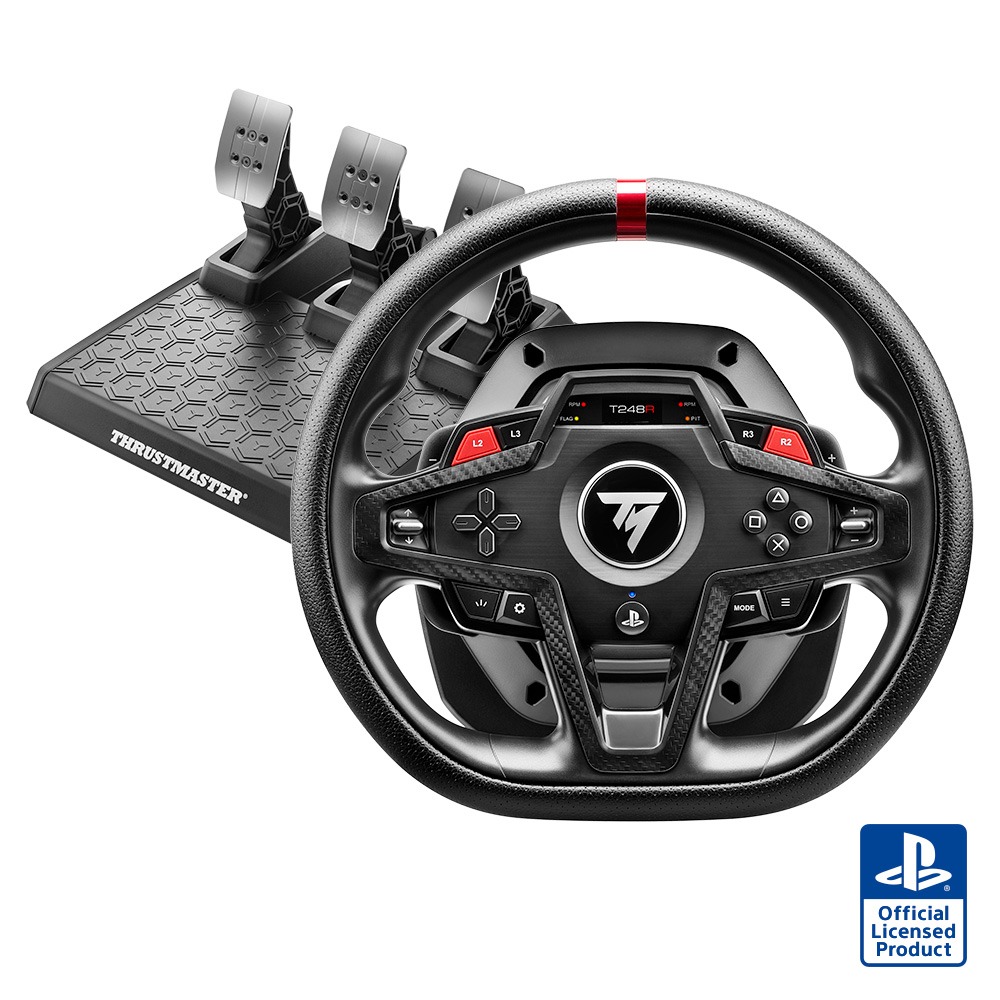 Thrustmaster T248R · Image: manufacturer
How does a belt-driven wheel base work?
In a belt-driven wheel base, the electric motor is not connected directly to the steering wheel. Its force travels through a toothed belt and pulleys of different diameters. That gearing multiplies the torque, so a fairly modest motor can still produce a useful amount of force at the rim.
The belt has a second effect. It smooths out the motor's pulses and filters part of the small vibrations coming from the game. The result feels softer and more forgiving, but also a little less precise. Some models combine a belt with gears, such as the T-HD (Hybrid Drive) system in the Thrustmaster T248.
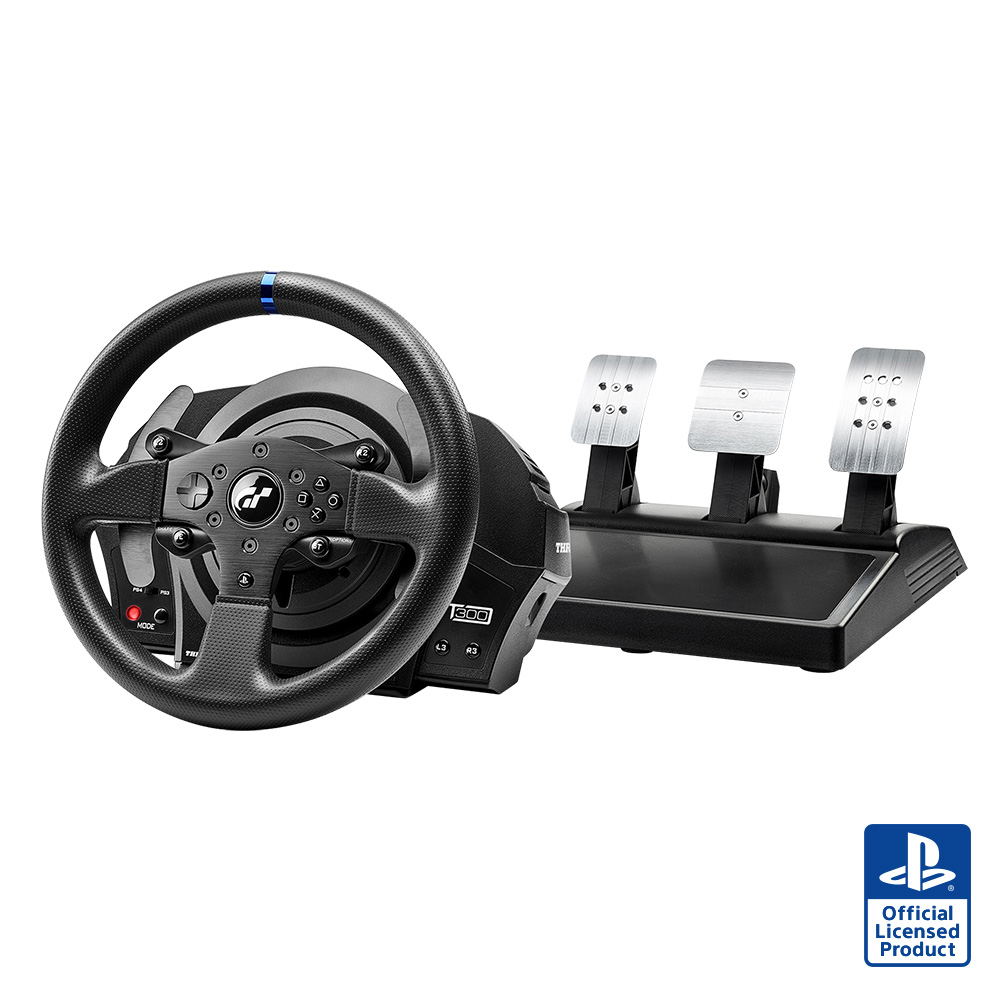
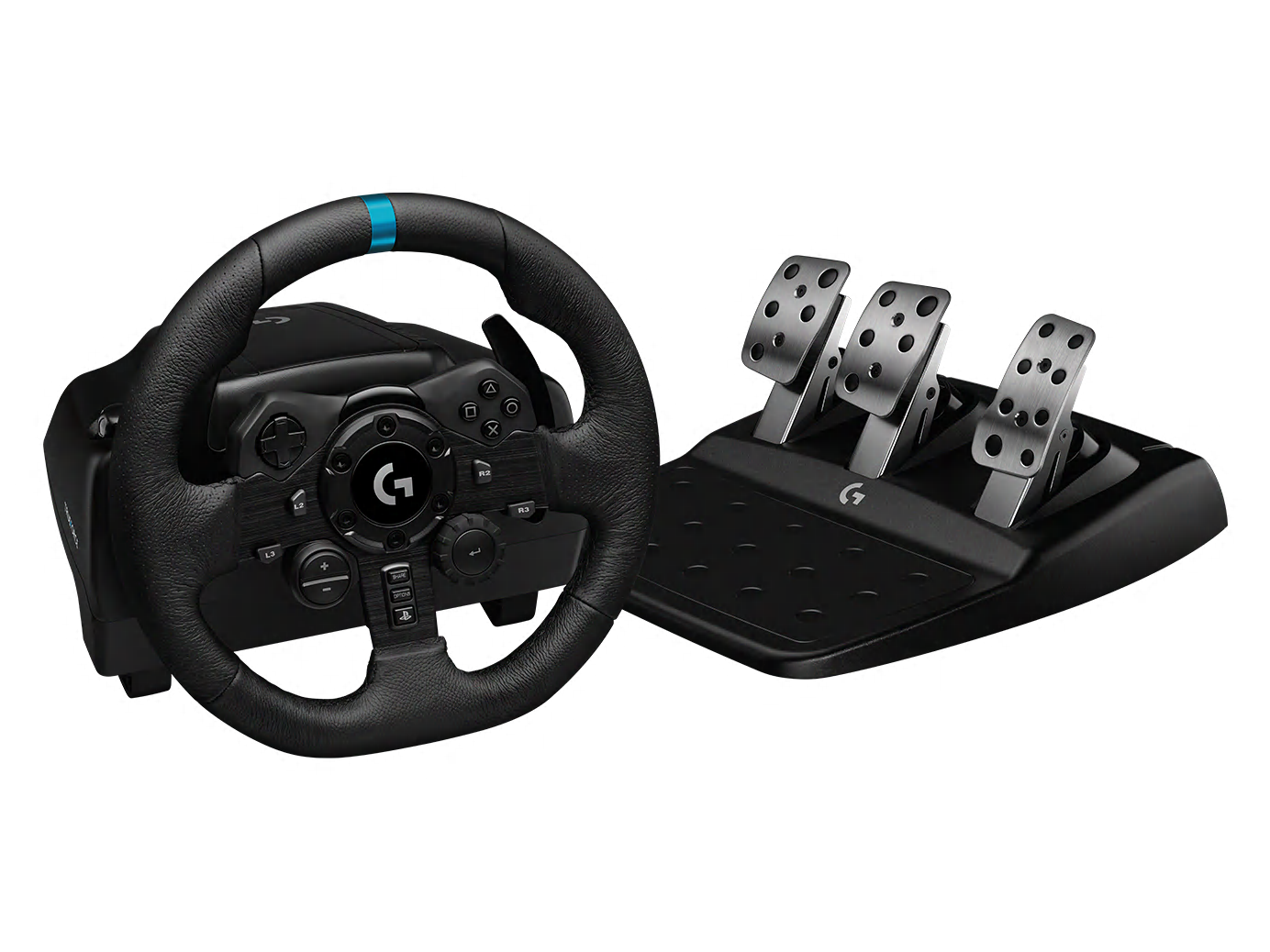
The Thrustmaster T300RS GT Edition uses a dual-belt system with a brushless motor, according to the manufacturer. Thrustmaster does not publish a torque figure in Nm for it. Logitech, for its part, does not state the drive type of the G923 on its French product page and quotes 2.3 Nm of force feedback.
For many people, this kind of wheel is their first contact with sim racing. The design is proven, widely available and often sold as a complete set with the wheel, base and pedals in a single box.
How does a direct drive wheel base work?
A direct drive base removes every intermediate part. The wheel is mounted on the shaft of a larger motor, which produces all of the torque by itself. Every signal sent by the game reaches your hands without passing through a belt or a gear train.
The result is faster and more detailed force feedback. You feel more clearly when the tyres start to lose grip, how the kerbs hit and how the weight of the car shifts under braking and turn-in. Because the motor is stronger, these bases also go much higher in torque: from 3.9 Nm for the MOZA R3 to 25 Nm for the Simucube 2 Pro, based on the figures published by the manufacturers.
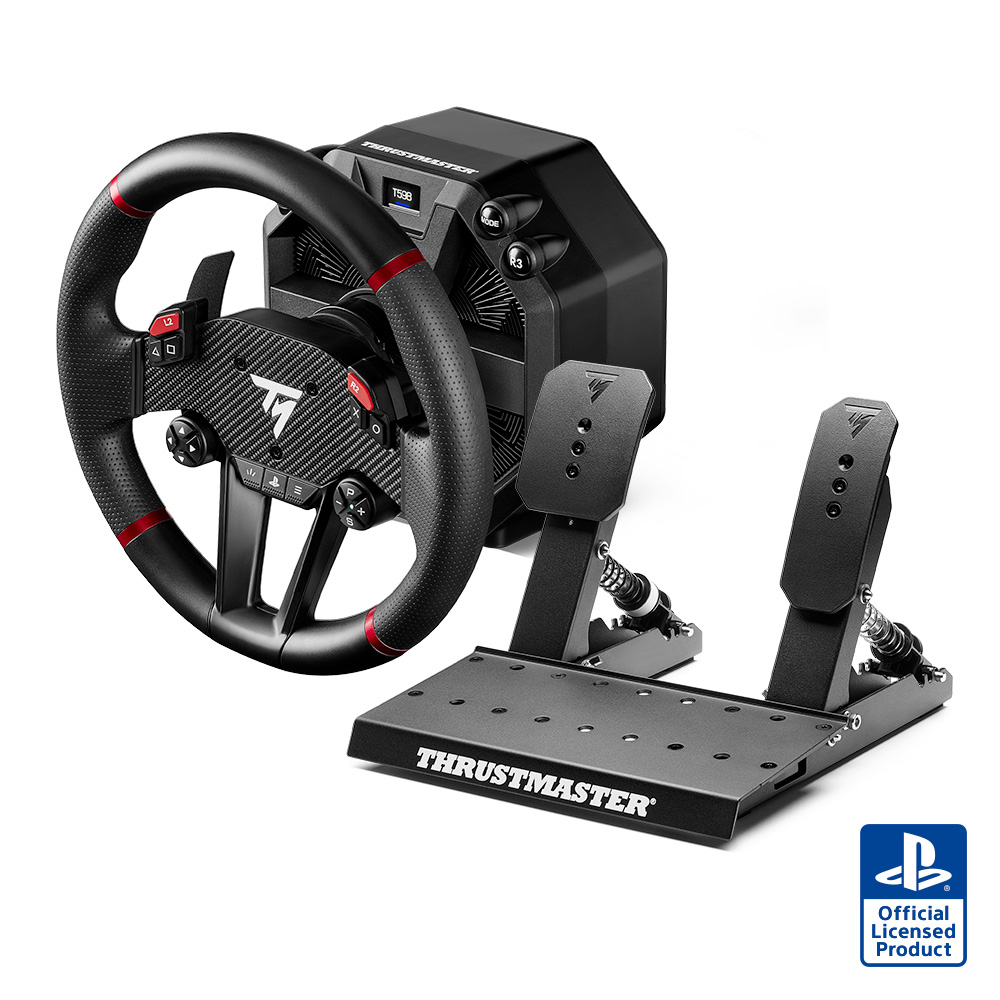
Manufacturers also highlight motors with low cogging, meaning no noticeable notchy feeling when you turn the wheel slowly. The Thrustmaster T598, for example, uses an Axial Flux motor that Thrustmaster describes as cogging-free.
What actually changes when you drive
The difference is not only about maximum force. It is mostly about the quality of the information. A direct drive base reproduces fine details even at low force levels, where a belt tends to dull them.
- Detail: direct drive passes on small changes in grip; a belt rounds them off.
- Responsiveness: without a belt, the delay between the game and the wheel is shorter.
- Noise: belt and gear systems make mechanical noise; a direct drive motor is usually quieter.
- Strength: direct drive allows much higher torque, which you can turn down to suit your taste.
- Maintenance: a belt is a mechanical part that wears over time; a direct drive motor has fewer wearing parts.
In practice, this means a stronger base is not automatically better for you. What matters is that the force feedback stays clear and readable at the level you are comfortable driving with for a full session.
Direct drive vs belt drive in numbers
The table below compares entry-level products from our catalogue. Torque values are those stated by the manufacturers. Prices were checked on 6 October 2026 on the official EU stores and include any discount running on that date.
| Product | Drive | Stated torque | Platforms | Checked price |
|---|---|---|---|---|
| Thrustmaster T248R | Belt + gears (T-HD) | 3.1 Nm | PC, PS5, PS4 | €249.99 |
| Logitech G923 (PlayStation/PC) | Not stated | 2.3 Nm | PC, PS5, PS4 | €299 |
| Thrustmaster T300RS GT Edition | Dual belt | Not published | PC, PS5, PS4 | €349.99 (out of stock on 6 Oct) |
| MOZA R3 (PC bundle) | Direct drive | 3.9 Nm | PC | €299 |
| Thrustmaster T598 | Direct drive | 5 Nm constant | PC, PS5, PS4 | €449.99 |
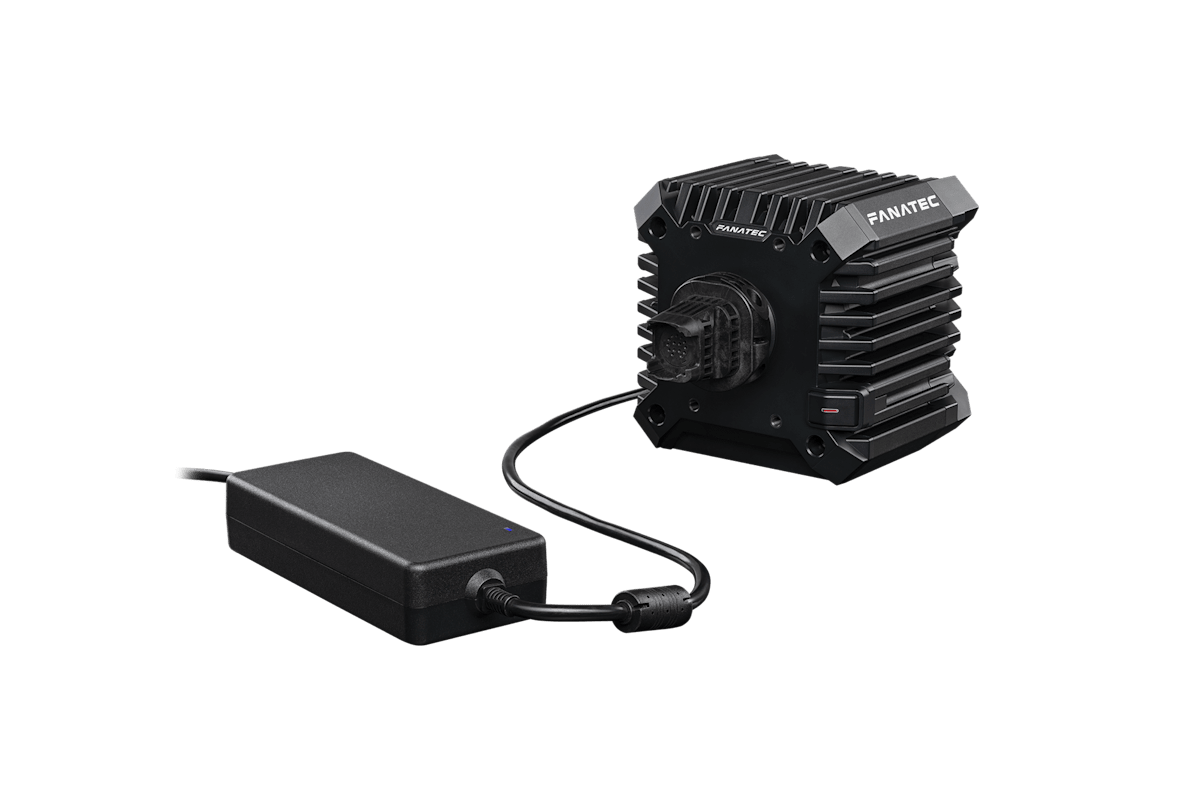
| Fanatec CSL DD Ready2Race 5 Nm | Direct drive | 5 Nm peak | PC | €509.95 |
The table shows one important thing. For a similar budget, a direct drive bundle does exist, but it is often PC only. On PlayStation, the T598 is one of the few direct drive options at around €450. You will find every model in our direct drive wheel base catalogue and in our comparison tool.
Who should still buy a belt-driven wheel?
A belt-driven base still makes sense if your total budget is around €300 or less. The T248R, priced at €249.99 when we checked on 6 October 2026, includes the base, the wheel and a three-pedal set. You can start racing without buying anything else.
It is also a good fit if you play on console and want to keep things simple. The Thrustmaster and Logitech models in this segment come in PlayStation/PC versions, and the manufacturers sell separate Xbox/PC versions. Check the exact model number before you order.
Finally, a belt-driven base is less demanding on your space. Its moderate torque is happy on a sturdy desk. It is a good way to find out whether sim racing is really for you before spending more.
Who should go straight to direct drive?
If you race on PC and want to get into demanding simulators, direct drive is the choice that will last longer. The MOZA R5 bundle, listed at €399 instead of €479 on 6 October 2026, includes a 5.5 Nm base, a wheel and a two-pedal set. The Fanatec CSL DD Ready2Race bundle also comes with a desk clamp.
Direct drive has another advantage: it is easier to upgrade. The MOZA, Fanatec and Thrustmaster ecosystems offer interchangeable wheels on a quick release. You can change the rim or the pedals later without replacing the base.
Costs to plan for beyond the wheel base
The price of a base on its own does not tell the whole story. A base such as the Fanatec CSL DD 8 Nm, checked at €429.95, ships without a wheel or pedals. Those need to be added to the budget.
- A wheel that fits the base's quick release.
- A set of pedals, if the bundle does not include one.
- A desk clamp, or a sim racing cockpit for higher torque levels.
- Sometimes a quick release adapter, which some brands such as Simagic or Simucube do not include.
To compare complete packages, see our beginner sim racing setup picks or use the rig builder. To decide how much power you need, read our guide on how much torque you need for a direct drive wheel.
Figures from official manufacturer spec sheets and market prices checked on 6 October 2026. Not a hands-on test: see our methodology.
Frequently asked questions
Is direct drive worth the extra money for a beginner?
Yes, if you race on PC and plan to stick with it: complete bundles start at €299 (MOZA R3, price checked on 6 October 2026). On console, the choice of entry-level direct drive is narrower, and a belt-driven wheel remains a good starting point.
Is a belt-driven wheel base noisy?
It makes mechanical noise from the belt and, depending on the model, from the gears. The level depends on the product and the force setting. A direct drive motor is generally quieter, but not completely silent.
Can you mount a direct drive wheel base on a desk?
Yes for lower torque bases, with a suitable clamp. Several bundles, such as the MOZA R3, MOZA R5 and Thrustmaster T598, include a mounting system. Beyond that, a cockpit is the better option.
Is the Logitech G923 direct drive?
No. Logitech does not state the drive type on its French product page and quotes 2.3 Nm of TRUEFORCE force feedback. The brand's direct drive model is the PRO Racing Wheel, rated at 11 Nm.